
The Strategic Imperative: Why Health Systems Must Decouple from Legacy MSPs and Agencies
- Greg Paulus

- Sep 18, 2025
- 8 min read
Healthcare organizations face an unprecedented staffing crisis that demands immediate transformation of workforce management strategies [1][2]. The traditional reliance on Managed Service Providers (MSPs) and conventional staffing agencies has become a critical liability, imposing excessive costs, operational inefficiencies, and technological obsolescence that directly impact patient care delivery [3][4]. The evidence overwhelmingly supports an immediate transition to on-demand marketplace platforms that eliminate intermediary dependencies and deliver superior performance across all operational metrics [5][6].
The Financial Crisis of Legacy MSP Models
Escalating Costs and Hidden Fees
Legacy MSP programs impose a devastating financial burden on healthcare organizations through escalating fee structures and hidden costs that contradict efficiency gains seen in other industries [3][7]. MSP fees in healthcare have risen to 7% and above, significantly exceeding the 2-3.5% range typical in other sectors, while simultaneously reducing competition among vendors and inflating bill rates [3][8]. The total cost impact extends beyond visible fees to include implementation costs, technology fees, and reduced negotiating power with suppliers, often resulting in 58.4% higher costs compared to direct marketplace models [3][8].
For a mid-sized health system utilizing 50,000 annual per diem hours, the financial impact is stark: MSP models cost $1,750,000 annually, compared to $1,000,000 for on-demand platforms, representing an immediate savings of $750,000, or a 43% cost reduction.

The financial disparity becomes even more pronounced when examining the detailed cost structure. MSP models burden healthcare organizations with multiple layers of fees that on-demand platforms eliminate entirely. The 7% MSP fee alone represents $122,500 in additional costs, while hidden expenses from communication delays, reduced vendor competition, and poor market access add another $105,000 annually.

Most MSP programs operate under supplier-funded models, meaning staffing suppliers pay the MSP fee, which creates inflated bill rates and reduces competition among vendors, ultimately increasing costs for healthcare organizations [3][8].
Operational Inefficiencies and Performance Degradation
MSP models create significant operational bottlenecks that directly compromise patient care delivery through communication delays averaging 40 hours as requests flow through multiple intermediaries [8][9]. The complex administrative layers result in poor fill rates of 80-85% compared to 95% achievable through direct marketplace platforms, while limited vendor pools reduce competition and access to high-quality agencies that opt out of MSP programs due to reduced profit margins [7][9].
The performance gap between MSP models and on-demand platforms is striking across all key operational metrics. Response rates improve from a dismal 3-5% to an impressive 75%, while response times decrease from 30-40 hours to just 15 minutes. These improvements translate directly into better patient care coverage and reduced staffing emergencies.

Large-scale MSP operations lead to communication delays and long response times, making it difficult to determine priority when multiple hospitals submit orders simultaneously [10][9]. The bureaucratic overhead forces healthcare facilities to sink unnecessary full-time equivalent hours into the staffing process while losing control and transparency over workforce management [8][9].
The Technology Revolution: Why Legacy Models Are Obsolete
Digital Transformation and Platform Superiority
The healthcare staffing industry is experiencing rapid digitization, with 94% of healthcare companies reporting AI and machine learning usage for workforce management [11][6]. Digital staffing platforms are gaining market share through automation and cost reduction, potentially rendering traditional agencies obsolete due to their superior technology capabilities [12][6]. Modern on-demand platforms achieve technology capability scores of 9.4/10 compared to MSP scores of 2.7/10, representing a 6.7-point technology advantage that directly translates to operational superiority.
The technology adoption gap between MSP models and on-demand platforms reveals a fundamental divide in organizational capabilities. While on-demand platforms leverage AI and machine learning at 94% adoption rates, MSP models lag significantly at just 15% adoption. This disparity extends across all critical technology features, from mobile-first design to real-time analytics.

AI-powered platforms excel in predictive analytics, automated candidate matching, real-time data processing, and mobile-first design that appeals to modern healthcare professionals [6][13]. These platforms leverage AI algorithms to predict candidate no-show risk, inform buyers on fill rate probabilities based on selected pay rates, and forecast potential shifts in demand, enabling dynamic pricing models that leave traditional fixed pricing as an outdated approach [6][13].
Mobile-First Architecture and Real-Time Capabilities
On-demand platforms achieve 75% response rates compared to 3-5% for traditional MSP models through mobile-first architecture and real-time availability systems [14][15]. Modern platforms enable an average response time of 15 minutes, compared to 30-40 hours for MSP models, while providing native mobile applications that healthcare professionals increasingly demand [16][15]. The platforms offer real-time analytics, automated workflows, and excellent integration capabilities compared to manual processes and poor integration in legacy systems.
Market Evolution and Industry Trends
Accelerating Platform Adoption
The healthcare staffing market is undergoing a fundamental transformation, with platform models gaining share from traditional staffing approaches across all healthcare subsegments [6][17]. Platforms represented more than 20% of US temporary staffing revenue in 2023, up from just 9% in 2020, demonstrating rapid market acceptance and superior scalability [6]. According to staffing firm surveys, the implementation of staffing platforms boosted revenue by a median of 10% while providing greater operating efficiencies [6].
Market projections indicate that the MSP market share will decline from 45% in 2023 to 18% by 2030, while on-demand platforms are expected to capture a 66% market share by 2030. This dramatic shift reflects the fundamental advantages of direct marketplace models over intermediary-dependent systems.

Healthcare Industry Digital Adoption
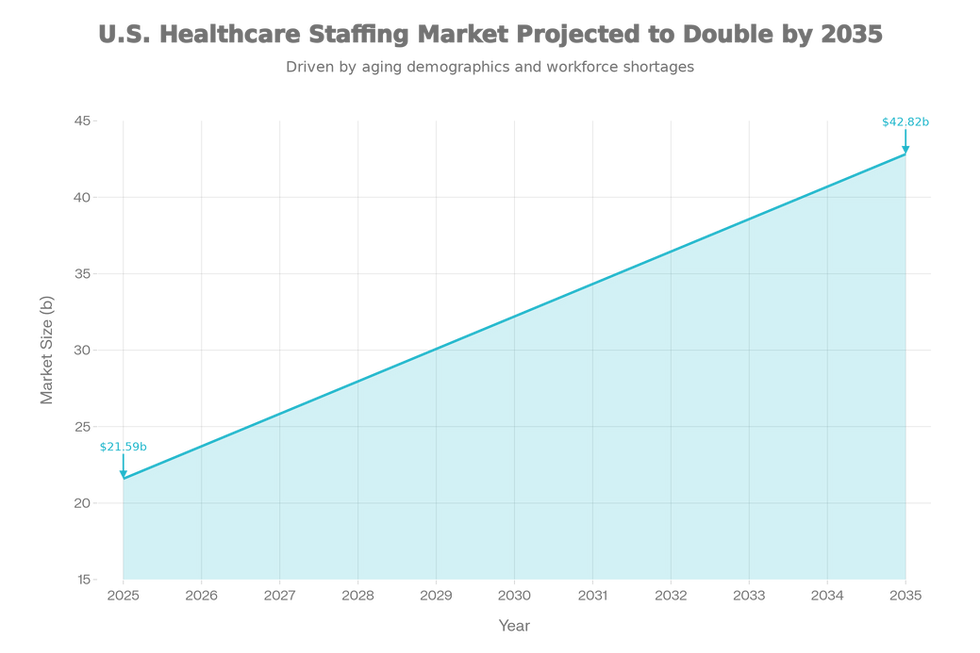
The healthcare staffing market continues to experience robust growth, with the overall market projected to expand from $44.1 billion in 2024 to $71.9 billion by 2033, representing a 5.31% compound annual growth rate. The per diem segment shows even stronger growth, expanding from $8.7 billion to $16.4 billion over the same period with a 6.5% CAGR, driven by increasing demand for flexible staffing solutions [18].

Healthcare workforce management is evolving toward technology-dependent care teams, where AI is expected to manage over 85% of customer interactions by 2025, thereby reducing human intervention requirements and enabling healthcare professionals to focus on patient care [19]. Automation and AI-powered chatbots are streamlining candidate vetting and onboarding processes, leading to increased efficiency and reduced administrative burdens [13]. The industry trend toward predictive workforce planning enables organizations to reduce overtime costs by 20%, decrease nurse turnover rates by 15%, and improve patient satisfaction scores through adequate staffing levels [20].
Operational Excellence Through Platform Innovation
Superior Performance Metrics
On-demand platforms deliver dramatically superior operational performance across all key metrics compared to legacy MSP and agency models [5][16]. Response rates improve from 3-5% (MSP) to 75% (on-demand), while fill rates increase from 80-85% (MSP) to 95% (on-demand), ensuring consistent staffing coverage. Time-to-fill positions improves from 30-40 hours (MSP) to 15 minutes (on-demand), enabling rapid response to staffing needs and improved patient care continuity.
The elimination of communication intermediaries enables direct nurse-facility relationships that improve care quality and nurse satisfaction while providing complete transparency into staffing pipelines [5][21]. Real-time data processing and automated matching ensure optimal nurse-facility pairing based on skills, experience, and preferences, maximizing both operational efficiency and care quality [16][22].
Crisis Response and Scalability
On-demand platforms demonstrate excellent scalability during crisis situations compared to the poor crisis response capabilities of MSP models. The platforms provide immediate surge capacity during emergencies through flexible per-shift contracting, as opposed to rigid MSP contracts that limit response flexibility [23][24]. Modern platforms handle spikes in demand more effectively than traditional staffing models through processing efficiencies and scalable technology architecture [6].
Healthcare facilities utilizing on-demand platforms can adjust staffing levels in real-time to meet patient care demands, significantly reducing operational costs and improving patient care by ensuring staffing closely matches need [24][21]. This flexibility reduces both understaffing and overstaffing scenarios, allowing healthcare professionals to work when most needed, thereby enhancing job satisfaction and reducing burnout [24].
Strategic Implementation Framework
Immediate Action Steps
Healthcare organizations should implement phased transition strategies, starting with pilot deployments in high-volume units, to document cost savings and efficiency gains. The implementation timeline for on-demand platforms typically requires only 2-4 weeks, compared to 6-12 months for MSP programs, enabling rapid deployment and an immediate return on investment. Performance validation during pilot phases provides essential evidence for enterprise-wide expansion and stakeholder buy-in [4].
The return on investment for transitioning to on-demand platforms is immediate and substantial. Organizations begin realizing savings from the first month of implementation, with cumulative annual savings reaching $750,000 for a typical mid-sized health system. The absence of lengthy contract negotiations and complex integrations enables healthcare organizations to quickly capture these benefits.

Organizations must assess current MSP contract terms and identify opportunities for strategic disengagement while building direct relationships with high-performing staffing providers [7]. The transition requires cross-functional teams, including HR analysts, operations managers, clinical leaders, and IT specialists, to ensure successful platform integration and change management [20].
Risk Mitigation and Competitive Advantage
The shift away from MSP models eliminates multiple risk factors, including rising fees, communication delays, limited vendor pools, technology platform obsolescence, and poor crisis response capabilities. On-demand platforms provide zero intermediary fees, direct quality control relationships, modern technology stacks with regular updates, and immediate scalability during demand surges. Performance-based contracting ensures accountability and service quality while maintaining operational flexibility [22].
Early adopters of on-demand platforms gain significant competitive advantages through superior cost structures, enhanced operational efficiency, and improved nurse satisfaction, leading to better retention rates [25][26]. The technology advantage becomes self-reinforcing as AI algorithms continuously improve through platform data collection and machine learning optimization [6].
Conclusion: The Strategic Imperative
The evidence overwhelmingly demonstrates that health systems must immediately begin decoupling from legacy MSP and traditional agency models to remain competitive and financially sustainable [27][28]. The combination of a 43% cost reduction, a 15x improvement in response rates, and superior technology capabilities creates an irrefutable business case for transitioning to on-demand marketplace platforms. Healthcare organizations that delay this transition face continued financial hemorrhaging, operational inefficiencies, and competitive disadvantage in an increasingly challenging market environment [29][30].
The healthcare staffing market's evolution toward platform-based models is irreversible, with on-demand platforms projected to capture the majority of the market share by 2030. Organizations must act decisively to capture first-mover advantages and avoid the escalating costs and declining performance of outdated MSP models, which threaten both financial sustainability and patient care quality [3][6].
The data clearly demonstrates that the question is not whether healthcare organizations should transition to on-demand platforms, but how quickly they can implement this transformation to capture the substantial operational and financial benefits while their competitors remain trapped in legacy systems.
11. https://www.staffingindustry.com/research/research-reports/americas/us-healthcare-staffing-market-assessment-2024-update
14. https://www.shiftmed.com/insights/knowledge-center/the-impact-of-technology-on-healthcare-staffing-opportunities-and-challenges/
16. https://www.staffingindustry.com/research/research-reports/americas/vms-and-msp-fees-and-recommended-msps-survey-insights
17. https://www.biospace.com/press-releases/u-s-healthcare-staffing-market-size-to-hit-usd-33-860-million-by-2034


Comments